
https://venezuelanalysis.com/news/venezuelan-armed-forces-bomb-eln-guerrilla-camp-reports/
The operation allegedly relied on US intelligence support, with open-access flight radar confirming the presence of US reconnaissance aircraft in Venezuelan territory.
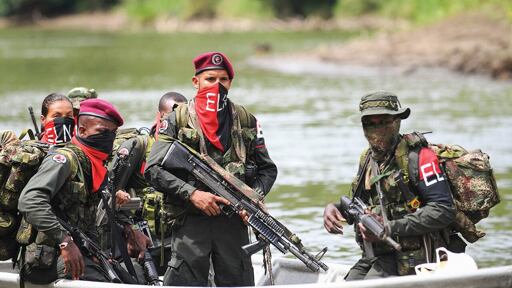
The Venezuelan armed forces reportedly attacked a camp belonging to Colombia’s National Liberation Army (ELN) in the Pedro Camejo municipality, Apure State, on Friday.
The military operation relied on US intelligence support, according to Stratfor-owned geopolitical and intelligence platform RANE Worldview.
The interior minister additionally rejected any foreign interference in Venezuelan affairs. However, open-access flight radar confirmed the presence of US military assets in Venezuelan territory in recent days, including reconnaissance planes spotted flying over border areas.
Since the January 3 US attack and kidnapping of President Nicolás Maduro, senior US military brass have visited the Caribbean country, including Southern Command Commander General Francis Donovan and Chairman of the Joint Chiefs of Staff Dan Caine.
In June, US forces conducted an airstrike in Bolívar State that they claimed to have extrajudicially executed Héctor “Niño” Guerrero, an alleged leader of the Tren de Aragua gang. Washington thanked Caracas for “cooperation,” while the Venezuelan government issued a statement informing of a “joint operation.”
Whole article:
Caracas, November 2, 2026 (venezuelanalysis.com) – The Venezuelan armed forces reportedly attacked a camp belonging to Colombia’s National Liberation Army (ELN) in the Pedro Camejo municipality, Apure State, on Friday.
The military operation relied on US intelligence support, according to Stratfor-owned geopolitical and intelligence platform RANE Worldview.
Local NGO Fundaredes stated the operation involved drones and combat helicopters and left 19 people killed, 10 of whom were identified by the forensic police in the state capital, San Fernando.
Fundaredes’ Apure director Javier García alleged that the ELN uses the area as a drug storage and logistics point. Right-wing news portal Infobae claimed that the attack also targeted camouflaged drug-transporting aircraft belonging to the ELN.
On Sunday, Fundaredes reported “armed clashes” which included drones in the Cedeño municipality of Bolívar State, close to the operations of state-owned bauxite mining and processing company BAUXILUM. According to Fundaredes, local miners were forced to leave the area and operations were temporarily suspended. However, the NGO did not identify who conducted the attacks.
The Venezuelan government and armed forces have not issued statements on the reported altercations in Apure and Bolívar. The Communications Ministry did not reply to a request for comment.
Venezuelan Interior Minister Diosdado Cabello said at a press conference on Monday that the country’s army and security forces had been deployed along the 2,200-kilometer border with Colombia to “prevent” any fallout from increased “conflict” in Colombia.
“We do not want any conflicts that are not ours,” Cabello said. He did not address the reports of an operation against the ELN.
The interior minister additionally rejected any foreign interference in Venezuelan affairs. However, open-access flight radar confirmed the presence of US military assets in Venezuelan territory in recent days, including reconnaissance planes spotted flying over border areas.
Since the January 3 US attack and kidnapping of President Nicolás Maduro, senior US military brass have visited the Caribbean country, including Southern Command Commander General Francis Donovan and Chairman of the Joint Chiefs of Staff Dan Caine.
In June, US forces conducted an airstrike in Bolívar State that they claimed to have extrajudicially executed Héctor “Niño” Guerrero, an alleged leader of the Tren de Aragua gang. Washington thanked Caracas for “cooperation,” while the Venezuelan government issued a statement informing of a “joint operation.”
The Trump administration has not commented on the reported strikes against the Colombian armed group. During a September visit to Colombia, US Secretary of State Marco Rubio referred to the presence of the ELN and dissident factions of the demobilized Revolutionary Armed Forces of Colombia (FARC) as an issue that “needs to be addressed” by Venezuelan authorities.
Since taking office in August, far-right Colombian President Abelardo de la Espriella has launched a “total offensive” against the ELN, with multiple airstrikes, security raids, and the militarization of Cúcuta, a major town on the border with Venezuela. It has also joined the Washington-led and funded “Shield of the Americas,” a regional alliance with an express goal of cracking down on transnational crime and migration.
For its part, the rebel group has vowed to resist and condemned US intervention in the region.
The ELN is the longest active guerrilla group in Colombia, having sustained a decades-long insurgency against the Colombian state. The organization maintained an arms-length relationship with the Bolivarian government under Chávez and Maduro, operating across the vast southwestern border uncontrolled by both nations and at times cooperating with Venezuelan authorities against Colombian paramilitaries and dissident FARC elements.
The Nicolás Maduro government supported former Colombian President Gustavo Petro’s efforts to negotiate a peace agreement with the ELN, with multiple negotiating rounds held in Caracas. However, hostilities from both sides persisted and the talks broke down.
Venezuelan authorities have repeatedly denied the sustained presence of Colombian armed groups on their side of the border. In 2021, the Venezuelan army launched an operation against dissident FARC elements in Apure State, with weeks of clashes causing dozens of casualties and thousands of displaced civilians. The ELN was widely rumored to have assisted in the operation.
I don’t what now? I was just having a laugh that the previous poster grouped them in with the ‘other than socialist states’. It’s, of course, impossible that they made a mistake and it can only be explained away with me not understanding anything about theory ;-)
The way I and others are reading your comment is that you believe China and NK are not communists. If that is your belief, then my previous comment stands. If not I retract it. You’re being sort of obtuse and not really clarifying.
Sorry for not clarifying but I didn’t think the comment thread was that complex
Personally yeah I believe that China and NK are some of the more communist led countries. For the latter I’m afraid they devolved into more of a nationalist monarchy
Nah man same exact system as the Soviet Union, Cuba and China. The Kim’s position is an elected position and the assembly repeatedly puts a Kim in that position.
Why? That’s a cultural issue. They do it because they believe the tie to the revolution is a useful pillar of stability. Now we can argue about whether or not they need that pillar but keep in mind that they’re under the strongest sanctions of any country in the entire world, they have the US occupying what they see as half their country, which they fought a war over and lost 20% of their entire population to mass genocide by the US. That leaves a cultural imprint.
Maybe this is easier for me to understand because I live in the UK. The majority of the British population supports keeping the monarchy, why? Cultural reasons. Except in Britain’s case it’s an actual real monarchy whereas in the DPRK’s case they can change this tradition at any time they want to change it through simply electing a different person to that position. It will happen eventually, and it won’t need a revolution or a civil war for it to happen. In the UK however we can’t change that shit even if we want to.
As for the “nationalist” part, I don’t really agree. Why is the DPRK fighting in Russia against imperialist forces? Why is it supplying weapons to Palestine? Why is it carrying out infrastructure projects with tens of thousands of workers in Africa? Nationalism? Or internationalism?
I think you have simply mistaken fiery rhetoric aimed at protecting themselves from the US killing another 20% of their population for “nationalism” when it is completely warranted behaviour against what is possibly the single most evil and nationalist country on this planet, the US.
Removed by mod
What a fucking disgusting twisting of what happened in Korea post WW2. You should be ashamed of yourself.
That latter statement is basically exclusively from the domain of imperialist propaganda…
Citation needed
Let’s just say it’ll be interesting to see if they hit 4 in a row ;-)
Ok well no investigation, no right to speak 🤷🏿♂️ lmao banned 💀