

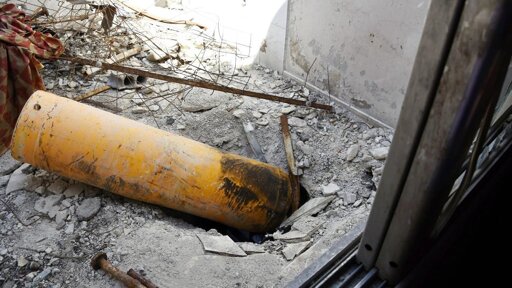
However, an engineering report conducted by the mission and a toxicology report commissioned from experts in Germany showed that the victims could not have been killed by chlorine gas and that the yellow cylinders that allegedly were dropped by helicopter to deliver the gas were likely placed on the roof and on the bed by hand.
In other words, the engineering and toxicology reports provided evidence that the chemical attack may have been staged by activists linked to the western-backed armed groups fighting the Syrian government and that the 43 victims had been killed in another way, such as by the activists and militants involved in staging the attack.

Salfism and Wahabbism are to Islam what US white Christianity is to the rest of Christianity. I think people find it surprising when they speak to me on the topic of Wahabbis because I go from a relatively relaxed individual to someone who wishes the most draconian levels of deradicalization. It’s a bit of a trope to say that Sunni and Shia have been at eachothers throats for 1000s years but frankly speaking it’s not untrue.
Arab Sunnism has been completely taken hostage by doctrine influenced by imperialists and it can’t be ignored. Idislike doing Fitnah, but I don’t think it’s possible to come to a more sober analysis without confronting that the Arab Sunni Diaspora only cares for “The Muslim World” up until it concerns Iran. The second anything has even the slightest relation to Iran, it’s treated as more of a threat than zionism.
I have relatives who come from Sushi (Sunni-Shia) extended families. Although more recently things have started changing, there’s still a few topics that starting a discussion on is like stepping on a landmine.
Is this level of rivalry being this old actually true? Or has it been manufactured by salafism in the 19th-20th century?
Did not know folks called it that! Haha awesome!
Yes with an *.
Although what could be considered “Sunni Islam” is not quite as old (in particular the 4 different schools of thought), the roots that would form Sunnism existed from the outset along with Shi’ism.
The schism happened directly after the Prophet’s (pbuh) death. Shiites argue that the path of succession for the next leader of the Muslims (the Caliph) was a solved issue, citing that Ali Ibn Abi-Talib (AS), adoptive and legal son of the Prophet (pbuh) was clearly selected as the successor of the Prophet (pbuh).
However immediately after he had died, the different set of events took place, which Sunnis argue was correct.
After the Prophet (pbuh) died a group of his companions selected Abu-Bakr to succeed him as the first caliph. He would select Umar Ibn-Khatab to be his successor as the 2nd Caliph and left his succession up to a vote among 6 others he selected and ordained one if them a tie breaking vote.
From this Uthman ibn Affan would be selected as the 3rd Caliph, who was related to the old tribal elite that held power before their defeat against the Muslims. Uthman was assassinated due to political turmoil caused from appointing many of his family into positions of power, seizing land that had been owned in common to his own family members, and giving full access to the Islamic treasury for his family. (During the Prophet’s (pbuh) era Muslims received equal payments from the treasury which acted as a social safety net of sorts, so this change was very significant).
Uthman’s death left the various different factions of the Ummah at the time to select Ali Ibn Abi-Talib (AS), who’d been an advisor during all 3 previous Khalifa’s (though notably more ignored in Uthman’s time), as the 4th Caliph. Many of the Prophet’s (pbuh) policies were reestablished however the historic elite disliked this shift from the 3rd Caliph, and essentially a civil war broke out, where rhe various sides tried to claim legitimacy from their prior association with the Prophet (pbuh).
Sunnis argue that all 4 Caliphs were legitimate successors to the Prophet (pbuh) dye to them being his companions in life (Sahaba). Whereas us Shia only recognize the legitimacy of the 4th as a successor, along with a selection of his descendants (though which ones are disputed among the Shia sects, but 99% are Twelvers and hold to that tradition). All Shiites unanimously agree on the first three Imams,
1st Ali Ibn Abi-Talib (AS), then his two sons:
2nd Hasan Ibn Ali (AS),
3rd Hussein Ibn Ali (AS).
All 3 would be assassinated. Imam Ali (AS) from a poison strike on the back while he was praying in Ramadan (He is given the nickname Haydar often, which is why you may see some people refer to the late Ali Khamenei with that moniker). Imam Hassan (AS) had poison slipped in his food. And Imam Hussein (AS) was slaughtered along with his supporters on an ambush layer by the Caliph at the time, Yazid Ibn Muawieyeh, after being summoned by the Caliph. The ambush happened in Karbala, Iraq, is the event commemorated during Ashura in the Islamic month of Muharam.
I lay out all this background so it’s apparent why this schism has persisted throughout the millenia. Those who sided with Ali Ibn Abi-Talib called themselves Shi’ites (followers) of Ali. After that the different Shia sects (though outside of Twelvers they are few) disagree on the line of succession. However we all agree that the Abassids did not restore the caliphate to the proper successor (with each sects imams facing persecution).
Eventually the different sects would deal with the persecution in different ways and hold different theological positions on the issue of succession.
Zaydis followed one of Ali Ibn Abi-Talib’s great grandsons who staged a failed rebellion against the Ummayads. They are probably the most “Sunni-adjacent” of the Shia sects, due to their lack of contempt for the first 2 caliphs. They cropped up in prominence during various periods during the decline or after the fall of the Abassids, such as ruling the Buyyid dynasty, though the Buyyids eventually converted to Twelver Shi’ism.
Ismailis, following those descended from the son of Jafar As-Sadiq (AS) (Jafar as-Sadiq is the 6th, Twelver imam, and the reason why us Twelvers go by the name “Jafari”.) Followed their Imams to North Africa, where they’d eventually form the Fatimyd Caliphate. The Fatymids were relatively successful in Egypt but the Ismailis would be completely wiped out from Egypt by Saladin after he took power.
Musah Al-Kazim (AS), the 7th Twelver Imam and his descendants, would stay within the Abbasid Caliphate, regularly being imprisoned an assassinated. These would be the Twelvers, and they became prominent in parts of Iraq and Fars (Persian area of Iran) sometimes ruling but intermittently were dominated by Turkic empires like the Seljuks. Eventually however, the first Safavid king, Shah Ismail the 1st, would perform a brutal forced conversion campaign, which is the reason for Iran’s overwhelming Shia majority today.
This impressions of Sunnis outside of Iran, particularly the Ottoman empire which were the Safavids main rival, was heavily impacted by this campaign and is often still cited today by Sunnis as an example of Shia treachery. This was not helped by the fact that the Safavid interpretation of Shia Islam was particularly reactionary compared to other Shia factions at the time.
For Shias, the existence of Sunni Islam, which holds up figures we see as responsible for our persecution and often violent slaughter (Ashura is the largest annual pilgrimage for a reason) causes a lot of hostility. For Sunnis, things like Shah Ismail’s forced conversions, and the Fatymid’s minority rule over a Sunni majority (regardless of how religiously tolerant they largely were) along with Shi’ites consistent denunciation of their important figures, has caused Sunnis to be eternally suspicious about our intentions.
It’s a history that is soaked in blood from its outset, and it’s shaped how we perceive the world and eachother.
This was somewhat brief, as I’m not am expert regarding the 1400 years of continued Sunni-Shia conflict, but I highlighted some if the most well known aspects and provided the best background I could without making this an absurdly long comment.
Thanks for the taking the time for the write-up; I was broadly familiar but from a Sunni perspective (which I don’t this was too dissimilar). Starred.
It was this that prompted me to question whether the intensity of the modern schism was fueled by British and then the USAmerican empires. In my experience historical set backs are often have to be actively stoked materially in the present for that fire to continue to burn, and in the age of Western Hegemony the advantage of amplifying that divison is a tool that I suspect is too lucrative for them not to use.