- cross-posted to:
- world@quokk.au
- cross-posted to:
- world@quokk.au
You must log in or # to comment.
Soldiers began detonating stun grenades at the ten other shepherds and their sheep, but the Palestinians refused to retreat to their homes. The soldiers called for army and police backup, which arrived after a few minutes. Dozens of soldiers pushed the shepherds, detonating more stun grenades, firing tear gas, and marching behind every flock.
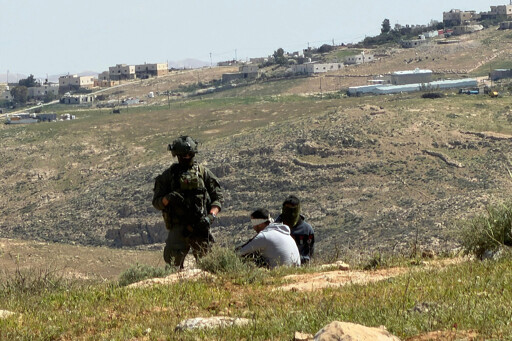
That morning, the army arrested eight shepherds, while injuring two other locals who required medical treatment. Soldiers tied the detainees’ wrists, blindfolded them, and led them to a military jeep, in full view of their families and young children.
One soldier conducted at least three arrests, then paused to photograph the crowd — images that would likely be integrated into Israel’s vast surveillance database. “The whole village came to cause trouble,” he said in Hebrew. Meanwhile, the settler watched from his nearby tractor, also taking photos of the Palestinians.
Soldiers are increasingly resorting to these arbitrary arrests, at times initiated by settlers’ presence on their land or false complaints. Even under the Israeli occupation’s discriminatory laws, there is no legal justification for these arrests; rather, they are simply a new tool to intimidate families across the West Bank.
“A particularly disturbing trend has intensified in recent months: soldiers simply taking Palestinians in what some would term abductions, which clearly constitute unlawful detentions,” The Human Rights Defenders Fund, a legal aid group, noted in a statement.
These arrests occur “without any involvement of law enforcement agencies, bypassing the legal procedures that normally require an arrest or detention to be reported to the police and the detainee brought to a police station,” the statement continued. “By taking Palestinians in this manner, soldiers and settlers can harass or abuse Palestinians without oversight.”
In the Rujum ‘Ulya area of Masafer Yatta, some >35 people have been arrested in this fashion over the past two months. The vast majority were detained by settlers wearing military-style uniforms, taken to nearby army bases rather than police stations, and held for hours — where they endured beatings and humiliation — before being released far from their homes.
Zionazis