
https://venezuelanalysis.com/news/venezuelan-armed-forces-bomb-eln-guerrilla-camp-reports/
The operation allegedly relied on US intelligence support, with open-access flight radar confirming the presence of US reconnaissance aircraft in Venezuelan territory.
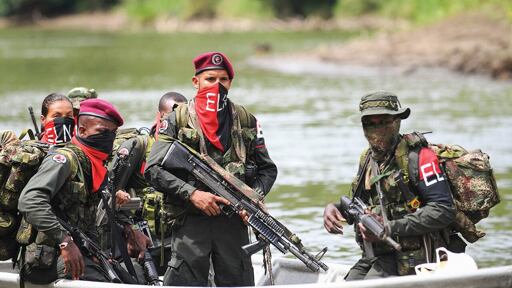
The Venezuelan armed forces reportedly attacked a camp belonging to Colombia’s National Liberation Army (ELN) in the Pedro Camejo municipality, Apure State, on Friday.
The military operation relied on US intelligence support, according to Stratfor-owned geopolitical and intelligence platform RANE Worldview.
The interior minister additionally rejected any foreign interference in Venezuelan affairs. However, open-access flight radar confirmed the presence of US military assets in Venezuelan territory in recent days, including reconnaissance planes spotted flying over border areas.
Since the January 3 US attack and kidnapping of President Nicolás Maduro, senior US military brass have visited the Caribbean country, including Southern Command Commander General Francis Donovan and Chairman of the Joint Chiefs of Staff Dan Caine.
In June, US forces conducted an airstrike in Bolívar State that they claimed to have extrajudicially executed Héctor “Niño” Guerrero, an alleged leader of the Tren de Aragua gang. Washington thanked Caracas for “cooperation,” while the Venezuelan government issued a statement informing of a “joint operation.”
Whole article:
Caracas, November 2, 2026 (venezuelanalysis.com) – The Venezuelan armed forces reportedly attacked a camp belonging to Colombia’s National Liberation Army (ELN) in the Pedro Camejo municipality, Apure State, on Friday.
The military operation relied on US intelligence support, according to Stratfor-owned geopolitical and intelligence platform RANE Worldview.
Local NGO Fundaredes stated the operation involved drones and combat helicopters and left 19 people killed, 10 of whom were identified by the forensic police in the state capital, San Fernando.
Fundaredes’ Apure director Javier García alleged that the ELN uses the area as a drug storage and logistics point. Right-wing news portal Infobae claimed that the attack also targeted camouflaged drug-transporting aircraft belonging to the ELN.
On Sunday, Fundaredes reported “armed clashes” which included drones in the Cedeño municipality of Bolívar State, close to the operations of state-owned bauxite mining and processing company BAUXILUM. According to Fundaredes, local miners were forced to leave the area and operations were temporarily suspended. However, the NGO did not identify who conducted the attacks.
The Venezuelan government and armed forces have not issued statements on the reported altercations in Apure and Bolívar. The Communications Ministry did not reply to a request for comment.
Venezuelan Interior Minister Diosdado Cabello said at a press conference on Monday that the country’s army and security forces had been deployed along the 2,200-kilometer border with Colombia to “prevent” any fallout from increased “conflict” in Colombia.
“We do not want any conflicts that are not ours,” Cabello said. He did not address the reports of an operation against the ELN.
The interior minister additionally rejected any foreign interference in Venezuelan affairs. However, open-access flight radar confirmed the presence of US military assets in Venezuelan territory in recent days, including reconnaissance planes spotted flying over border areas.
Since the January 3 US attack and kidnapping of President Nicolás Maduro, senior US military brass have visited the Caribbean country, including Southern Command Commander General Francis Donovan and Chairman of the Joint Chiefs of Staff Dan Caine.
In June, US forces conducted an airstrike in Bolívar State that they claimed to have extrajudicially executed Héctor “Niño” Guerrero, an alleged leader of the Tren de Aragua gang. Washington thanked Caracas for “cooperation,” while the Venezuelan government issued a statement informing of a “joint operation.”
The Trump administration has not commented on the reported strikes against the Colombian armed group. During a September visit to Colombia, US Secretary of State Marco Rubio referred to the presence of the ELN and dissident factions of the demobilized Revolutionary Armed Forces of Colombia (FARC) as an issue that “needs to be addressed” by Venezuelan authorities.
Since taking office in August, far-right Colombian President Abelardo de la Espriella has launched a “total offensive” against the ELN, with multiple airstrikes, security raids, and the militarization of Cúcuta, a major town on the border with Venezuela. It has also joined the Washington-led and funded “Shield of the Americas,” a regional alliance with an express goal of cracking down on transnational crime and migration.
For its part, the rebel group has vowed to resist and condemned US intervention in the region.
The ELN is the longest active guerrilla group in Colombia, having sustained a decades-long insurgency against the Colombian state. The organization maintained an arms-length relationship with the Bolivarian government under Chávez and Maduro, operating across the vast southwestern border uncontrolled by both nations and at times cooperating with Venezuelan authorities against Colombian paramilitaries and dissident FARC elements.
The Nicolás Maduro government supported former Colombian President Gustavo Petro’s efforts to negotiate a peace agreement with the ELN, with multiple negotiating rounds held in Caracas. However, hostilities from both sides persisted and the talks broke down.
Venezuelan authorities have repeatedly denied the sustained presence of Colombian armed groups on their side of the border. In 2021, the Venezuelan army launched an operation against dissident FARC elements in Apure State, with weeks of clashes causing dozens of casualties and thousands of displaced civilians. The ELN was widely rumored to have assisted in the operation.
The RF is not anti-imperialist because they are implementing a socialist project to which the imperialists are strictly materially opposed. The RF is anti-imperialist because the imperialists were and are opposed even to their national development as a regional power with basic degrees of sovereignty and participation in international markets, i.e. they were not allowed to join the club. The original project against Russia after the fall of the USSR, aside from dissolution of the member states from the union, was to strip it for parts and attempt to transfer as much ownership to the imperialists as possible following a privatizatiom by what Westerners now call oligarchs (even though the same groups exist in their own countries). This plan ran into a wrinkle, they basically created their own opposition: the interests of this national bourgeoisie was in maximizing their own profits, not simply giving up the game, and this aligned with nationalist state reconstruction of which Putin et al were solid members (also developed by imperialists!). And ever since the project has been to treat the RF as a Boogeyman and try to undercut it from resuming being a regional power and having strong levels of economic independence.
There is a long history of imperialists using these maximum pressure tactics against nations that, per liberal propaganda, should be friends with the imperialists and even try very hard to be so. But imperialists tend to do simple aggregated calculus on what maximizes their own levers of power vs. what other nations are seeking and decide to do things like refuse to sell weapons to a newly independent nation and then declare them an enemy when they buy from the only other option, the USSR, China, RF, etc. The idea that they simply want more nations to be like them is false. They want subservient clients slotted into their allotted place, that place chosen by capital.
The RF is anti-imperialist because imperialists are materially anti-RF and doggedly pursue policy to that effect.
What makes you say Russia was “not allowed to join the club”?
Of course they joined the club. Banking system, WTO, you name it.
Dividing up the crown jewels and turning into an oligarchy was done for Russians, by Russians.
I can address these things but as you have been banned I want to be clear I am not trying to “have the last word”, just offer information.
The RF was subjected to “shock therapy” of privatization at the hands of the IMF and US, without any supports that were given to other Eastern Bloc countries (though it was frequently disastrous there as well). The result was rapid privatization, of prior public guarantees, their degradation into either monopoly profit centers or just no longer existing in a recognizable form. Poverty shot up immediately, with little work, few to no safety nets, and a massive increase in mortality, tens of millions dying from the trim position of capitalism on Russia. As part of this degradation, “foreign investment” ballooned. This actually means foreign ownership buying up industry at pennies on the dollar. Foreign ownership means the national bourgeoisie don’t own it. Simultaneously, assets were liquidated and the capital was rushed out if the country. The RF was also saddled with a host of Western-declared debts, many of them bullshit. This treatment of the RF, again, contrasts with the treatment of many other former Soviet states: the RF was already being treated antagonistically and the common people were paying the price. As the RF stabilized somewhat under a new nationalist reorganization, this was also viewed as antagonistic by Western powers who continued to view successes of Russia as losses to their own positions in the imperialist system. This zero sum game is typical of the actors under the unipolar imperialist order. The greatest “crime” of the RF was the renationalization of oil and gas, the US wanted to own and control that industry in Russia, and that is when you get the now longstanding demonization of Russia as a supplier of energy to the rest of Europe. Simply doing the typical thing of selling a commodity on the market is evil hen Russia does it.
This is so ahistorical I’m not even going to respond to it.