
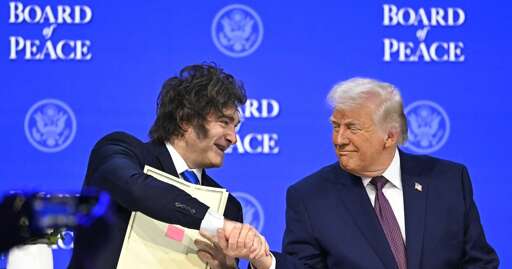
Argentina entrega todo y no recibe nada: qué dice la letra chica del acuerdo con Estados Unidoswww.pagina12.com.ar La Cancillería, que ni siquiera publicó el texto en español, emitió un comunicado destacando logros que no aparecen en el documento oficial. Argentina and the United States signed a trade agreement in which Argentina assumes 113 obligations, while only 8 are mutual obligations and 2 are solely the responsibility of the U.S. The official document, published in English by the U.S. Embassy itself , does not include the benefits promised by the Argentine Foreign Ministry. US controls will be sufficient to import Argentina must allow goods originating in the United States that comply with its technical regulations and evaluation procedures to enter the country without additional inspections. In this way, approval from the Food and Drug Administration (FDA) , the US equivalent of ANMAT, will be sufficient for the importation of medicines, food, and chemicals, among other things . The same applies to the Food Safety and Inspection Service (FSIS) , the equivalent of the local SENASA . Meat, poultry, and dairy products will only be allowed entry with FSIS authorization. Even agriculture is not spared: the sectors in which Argentina is opening up to the United States The agreement does not establish significant benefits for Argentine agriculture in exchange for importing industrial goods; rather, it opens Argentina up in both sectors . The agreement establishes annual quotas for food products produced in the United States that will enter the country duty-free , such as:
- 1000 tons of cheese
- 870 tons of almonds
- 80 tons of pistachios
- 1100 tons of potatoes
- 80,000 liters of wine
- 10,000 cars The National Government announced a supposed quota of 100,000 tons of Argentine meat that would enter the United States without tariffs, but not only does that not appear in the agreement, it is the opposite. “It is a decision by the United States government that is not included within the agreement,” said Pablo Quirno, Minister of Foreign Affairs, in a recent television interview. “It doesn’t seem like there was a negotiation, but rather a concession on the part of Argentina . The only thing that was defended was the current preference of a government, not national interests,” Juan Gabriel Tokatlian, PhD in International Relations, told Página|12. “One would have thought it would be an agreement to bring more agricultural products into the United States , which wouldn’t have generated jobs either, because it’s a sector that’s not very labor-intensive. But it’s not even that; this is even more unequal ,” warns Guido Bambini, an economic researcher at the Center for Argentine Political Economy (CEPA). At the same time, import duties are eliminated for laptops, fiber optic cables, and other technological items, without quotas. No taxes can be levied on software or streaming platforms either . This point is reciprocal, but in practice it benefits the United States, as it is the world’s leading power in these sectors. Preferential treatment for US companies Argentina will permit and facilitate US investment in its territory for the exploration and exploitation of critical minerals and energy resources and to provide power generation, telecommunications, transportation and infrastructure services. “US companies must be the first notified when oil and mining tenders are opened ,” emphasizes Eduardo Martínez, an international and geopolitical analyst. The agreement adds that Argentina must not impose new barriers on US suppliers or treat them less favorably than domestic companies or those from any other country. At the same time, the country commits to “addressing unfair trade practices by companies from third countries,” a clear reference to China. The United States will monitor Argentina’s industrial and foreign trade policy On the one hand, Argentina will not be able to impose taxes that “discriminate against U.S. companies.” On the other hand, it urges that if the United States imposes border or trade measures to defend its national security, our country should immediately take the same measures “when appropriate." It also pledges to cooperate with the United States “in a consistent manner” to ensure compliance with the sanctions and international trade controls that the United States applies to different countries. In the field of nuclear and energy, the purchase of nuclear reactors, fuel rods or enriched uranium from certain countries will be prohibited , with a focus on China and Russia . Argentina will not be able to subsidize its public companies “in a manner that distorts international trade” and, if requested by the United States, must provide information on all assistance it provides to domestic manufacturing companies . What does Argentina gain from the agreement? Argentina gains little to nothing from the agreement. Products such as tea, yerba mate, mangoes and tropical fruits, some juices and coffee , among a few others, will enter the United States duty-free . On animal products, pharmaceuticals, and steel and aluminum , provided they are for civil aviation and not for other industrial purposes, the United States promises not to impose extra tariffs, meaning they remain at the standard 10% . “The benefits for Argentina are very limited. In some cases, it only proposes eliminating additional tariffs that Trump imposed in April; there is no improvement. Furthermore, it includes many goods that Argentina does not export, such as inputs for aircraft construction or for the pharmaceutical sector ,” adds Julieta Zelicovich, PhD in International Relations and researcher at Fundar. For his part, Tokatlian asserts that “the Argentine government indulged itself by not consulting business leaders, workers, and politicians about the progress of its meetings .” “The social and political actors potentially affected by the agreements never demonstrated even the slightest capacity for collective action,” he reflects. “The only argument they throw at us is that the U.S. eliminates tariffs on products they don’t have. It’s a deficit in everything, it’s tailor-made for the United States ,” says Martínez. When does the agreement come into effect? While the agreement must be approved by both chambers, the Chamber of Deputies and the Senate , the text states that it “will enter into force 60 days after the parties have exchanged notifications certifying compliance with applicable legal procedures.” Either party may terminate the agreement, but must give at least six months’ notice.
Crosspost from https://lemmygrad.ml/post/10625254
This is really bad for the people of Argentina.
You must log in or # to comment.