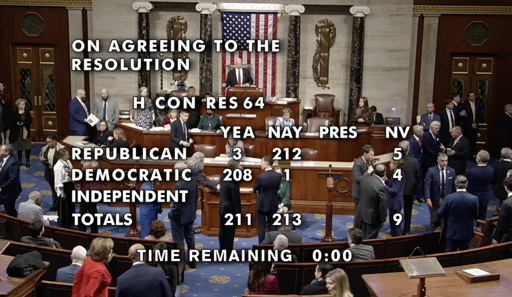
The House on Wednesday voted down a War Powers Resolution meant to block President Trump from launching a war with Venezuela without congressional authorization, as required by the Constitution. The bill failed in a vote of 211-213, with nine representatives not voting. Just three Republicans joined Democrats in supporting the…
What other commenters said, but there’s some nuance.
The US hasn’t techically declared a war since WWII, but it does get authorization from Congress to deploy troops and such. The Vietnam War, for instance, was ‘authorized’ with this: https://www.britannica.com/event/Gulf-of-Tonkin-Resolution
The later (for example) was nearly unanimous in Congress. They may be fudging the Constitution’s wording/intent some, but the president was not defying Congress, hence it wasn’t exactly a “Constitutional Crisis.”
…So, actually, your observation is corrent. This is different.
Trump has not gotten any blessing of Congress make a big war with Venezuela. He’s certainly not getting it.
But there’s never been a president with such a grip over their party in a long time.
It’s kind of an ‘unstoppable force’ vs ‘immovable object’ problem. Congressional Republicans can’t defy Trump so blatantly; it’d be political suicide. They can’t authorize a war with Venezuela either, as they don’t have the support of Democrats + ‘rebel’ Republicans to do it. Even if they did, it’d be political suicide.
So if Trump instigates something against Venezuela, what’s going to happen is quite unprecedented: a war Congress doesn’t approve of, but isn’t putting a stop to either. It’s not quite a “Constitutional Crisis” if Congress and the Supreme Court sit on their hands, but it sure is… something.
why would you need to vote for a law that basically just states that the constitution is still in place?
But to answer your original question:
why would you need to vote for a law that basically just states that the Constitution is still in place?
It’s because Congress has a trail of ‘implicit approval’ for wars. Like the resolutions linked above. So I suppose it’d be to clarify this war does not have their implicit approval.

What other commenters said, but there’s some nuance.
The US hasn’t techically declared a war since WWII, but it does get authorization from Congress to deploy troops and such. The Vietnam War, for instance, was ‘authorized’ with this: https://www.britannica.com/event/Gulf-of-Tonkin-Resolution
The War in Afganistant was this, and some other now-infamous bills that authorized stuff like mass surveilance: https://en.wikipedia.org/wiki/Authorization_for_Use_of_Military_Force_of_2001
The later (for example) was nearly unanimous in Congress. They may be fudging the Constitution’s wording/intent some, but the president was not defying Congress, hence it wasn’t exactly a “Constitutional Crisis.”
…So, actually, your observation is corrent. This is different.
Trump has not gotten any blessing of Congress make a big war with Venezuela. He’s certainly not getting it.
But there’s never been a president with such a grip over their party in a long time.
It’s kind of an ‘unstoppable force’ vs ‘immovable object’ problem. Congressional Republicans can’t defy Trump so blatantly; it’d be political suicide. They can’t authorize a war with Venezuela either, as they don’t have the support of Democrats + ‘rebel’ Republicans to do it. Even if they did, it’d be political suicide.
So if Trump instigates something against Venezuela, what’s going to happen is quite unprecedented: a war Congress doesn’t approve of, but isn’t putting a stop to either. It’s not quite a “Constitutional Crisis” if Congress and the Supreme Court sit on their hands, but it sure is… something.
But to answer your original question:
It’s because Congress has a trail of ‘implicit approval’ for wars. Like the resolutions linked above. So I suppose it’d be to clarify this war does not have their implicit approval.