

cross-posted from: https://mander.xyz/post/54715304
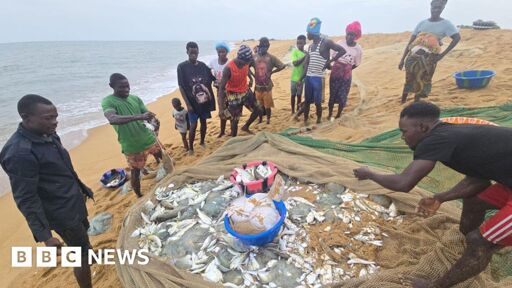
One woman, Marie Pierre [Sierra Leone’s Sherbo Island in West Africa], is picking sardines from among the discarded jelly fish. She says that international trawlers are illegally entering the coastal waters in ever larger numbers, despite there being an official exclusion zone to keep them out.
…
West Africa remains the global epicentre for illegal fishing. An estimated 40% of the world’s unlicensed catch can be traced to its waters, according to a 2024 global report.
The study estimated that this costs West African nations a combined $10bn in lost revenues, and risks the food security of millions of people. Commentators say that the situation has not improved in the subsequent two years.
Thomas Turay, president of Sierra Leone’s Fishermen’s Union, says that the average catches for his members are down some 40% in recent years. And he’s in no doubt where the blame lies.
“The illegal fishing is too much,” he says. “The sea belongs to us, but for the foreign trawlers, they come at night and violate the seven-mile exclusion zone, they come right into the shore here.”
…
So, what are nationalities of the international ships off the coast of Sierra Leone?
Steve Trent, CEO and co-founder of global campaign group Environmental Justice Foundation (EJF), says the vast majority are from China.
“In the past, we’ve seen South Korean vessels there, we’ve seen Taiwanese, we see European vessels there doing bad things. But now when you look across that region, it is overwhelmingly Chinese”.
…
Trent from the EJF says the Chinese government is adopting a head-in-the-sand approach.
“It’s simply not credible for them to carry on in this way. China, to date, still is not doing nearly enough to control its fleet. In fact, I would say they’re enabling it, through subsidies, through a lack of oversight and control.”
The solution, Trent says, needs to come from better tracking of commercial vessels, and increased international pressure on Beijing, including from consumers themselves. The fish taken from west Africa’s rich coastal waters is being sold for consumption around the world, he points out.
“You can choose, do you want to take a product that’s been fished illegally, probably unsustainably, stolen from a poor third-party nation, or do you want a product that you actually enjoy eating?”
…
They’re not the only ones. Chinese (and other) fishing fleets sure do have an issue with their transponder going out for a while. Aka going radio silent and fishing where they shouldn’t be, particularly in countries waters who don’t have the means to stop them.
No, they are not the only ones, but, as Steve Trent is cited,
“In the past, we’ve seen South Korean vessels there, we’ve seen Taiwanese, we see European vessels there doing bad things. But now when you look across that region, it is overwhelmingly Chinese”.
And the problem is not geographically confined to Africa. As the investigative platform The Outlaw Ocean states, the projects investigations run from “China’s reach into local waters” to well-resourced story how “Uyghurs forced to process the world’s fish”.
“China has expanded an armada of far-flung fishing vessels. And this has come at a grave human toll.”
The site offers well-researched - and, unfortunately, devastating - reports, including documentaries.
The Chinese fishing fleet is pretty renowned for causing issues with fishing globally. I can’t think of anyone else really on that level.
The site offers well-researched - and, unfortunately, devastating - reports, including documentaries.
Your third article cites Adrien Zenz.
That’s not to say that there’s not Chinese fishermen fishing illegally in places where they won’t be punished for doing so, but they clearly don’t vet their information if they’re citing that guy.