

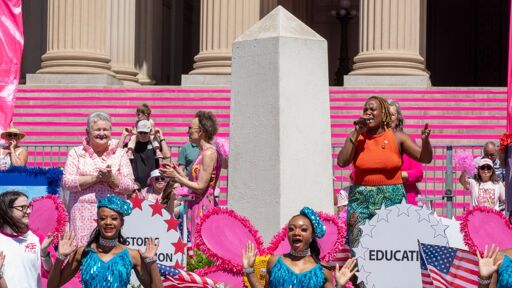
After right-wing media outlets picked up the story with an anti-trans angle, implying there was a policy change that suddenly allowed trans women to join, rather than a clarification of existing bylaws, a group of DAR members began lobbying to ban trans women from the organization. A small percentage of members even left the organization after DAR leadership made it clear that trans members were welcome, per The Washingtonian.
The DAR governing body rejected the first official proposal for bylaw amendments that would ban trans women in February 2025, after its Texas chapter put them forward. After national lobbying from a group of members called Daughters Advocating for Restoration, which claims to advocate for “preservation of Historic American Societies for Women,” the proposed bylaw amendments that would exclude trans women from the DAR’s definition of women were added to matters put to a national member vote.
…
The matter officially came to a head on Friday at the 135th Continental Congress, where members voted 1,481-984 against defining woman as “born female,” allowing trans members of the DAR to remain.
“The movement against discrimination within the DAR is not about “special treatment” or changing history. It is about treating every applicant and every member with dignity and respect,” another member wrote in the group’s Facebook page. “Transgender Americans are patriots, family members, volunteers, historians, and descendants of Revolutionary War ancestors just like anyone else. Excluding or targeting people because of their gender identity contradicts the values of respect, service, and sisterhood that the DAR claims to uphold.”
As a legit Son of the American Revolution, well done ladies. Bigotry was not one of our founding principles.
You say that, but…
It was not until the passing of the Fifteenth Amendment that men of all races were allowed to vote:
And it would be another 50 years before women were granted the right to vote:
There’s some other interesting bits in here:
https://en.wikipedia.org/wiki/Voting_rights_in_the_United_States#Milestones_of_national_franchise_changes
So… it seems like the bigotry has kind of always been part of the system, and had to be specifically legislated against ex post facto.
Excellent post. Well done.
Well, credit to Wikipedia and the people who spend so much time maintaining the articles there.
One other note I’ll make, just to avoid misinterpretation: repeating this information in this context might make it seem like I am particularly critical of the US, but I am not.
Very few other nations have such a legislative history of various groups being explicitly enfranchised. This is because in most other nations, disenfranchised groups are rarely if ever enfranchised throughout the nation’s entire history. The fact that the US has so many such instances in its legal history puts it in front of other nations in this context, not behind.
Dealing with bigotry in the US has been a long and violent process, and we’re not done, but at least we are dealing with it.