
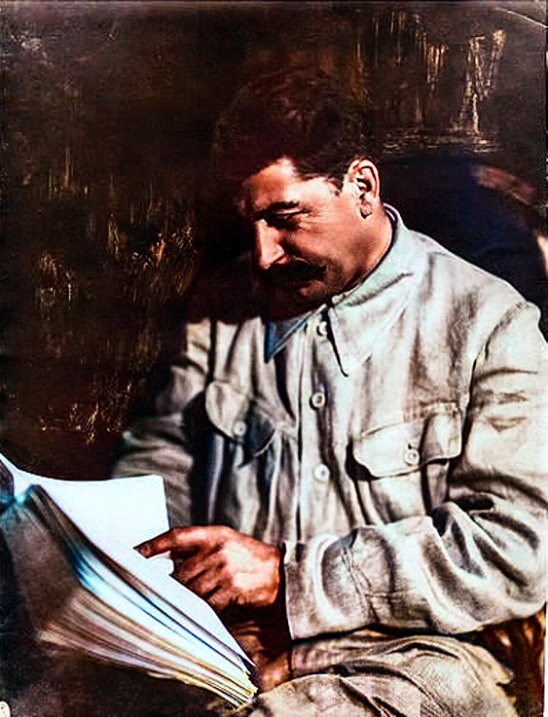
To be real, I really would like to snag a bottle for myself. Preferably a bottle of Khvanchkara.
News article from Reuters, direct link to website
TBILISI, May 29 (Reuters) - Tangled cobwebs dangle from the ceiling in dim light and a pleasant, musky sweetness pervades the air in this repository of a precious wine collection, once owned by Georgia’s most infamous son, Josef Stalin.
The Georgian government, which owns the roughly 40,000 French and Georgian rarities, unsealed the wine vault for the first time this week in the capital Tbilisi.
It plans to auction off the collection, some of which dates from the early 19th century, and use the funds to open a wine education school in Georgia.
Irakli Gilauri, the owner of Gilauri Wines who worked with Georgia’s agriculture ministry on the project, said the auction would help to “put Georgia on the collectors’ map”.
The South Caucasus country sells itself as the birthplace of wine, with archaeological evidence demonstrating a continuous wine-making tradition stretching back 8,000 years.
Stalin, who was born in Georgia and led the Soviet Union from 1924 until his death in 1953, was an enthusiastic wine drinker and collector.
His trove includes wine from Bordeaux’s most famous estates that were once owned by Russia’s Tsar Alexander III and his son Nicholas II. The Soviets seized the Imperial Romanov collection after the 1917 Russian Revolution, and Stalin became its guardian, slowly adding his favourite Georgian varieties.
Peering into the dust-covered bottles at the amber liquid inside, collector Victor Chen, who travelled to Tbilisi from Dallas, Texas, was excited by what he saw.
“I feel like you’re Indiana Jones opening up a cave: it could be nothing, it could be something,” he said, referring to the fictional swashbuckling archaeologist from the film franchise.
“There’s not many things that are still historical moments at this point. And this could be one of them.”
Sounds more like the new state (USSR) seized what was either property of the old state, or personal property of the Romanovs (the line may be fuzzy, I’m not a Russian lawyer). Then Stalin became its “guardian,” which sounds more like he was keeping the collection from being looted/sold off than personally owning it and treating it as his individual property. Him adding to it, it still being around today, and it being owned by the Georgian government all tracks with this.
Seems like a pet project more than anything. I could see an argument that he should have done something else with it, but it’s pretty small in the scheme of things, and I can also see keeping this around for diplomatic events or cultural reasons.
Being wine guys
Yeah, this is the equivalent of a state art collection. Especially since wine is a huge thing in that part of Eastern Europe (hence him adding a ton of local varieties).
Having a collection like that is a political tool, and a way to archive the labor of regional wineries.
It would be one thing if there were stories of Stalin being a massive lush, who burned through this rare and expensive wine as if it meant nothing. That doesn’t seem to be the case, though.
I think I remember his drinking really accelerated after the war. You can’t smoke and drink like that and not have it battering at your heart like a horde of barbarians
But I don’t remember anything about him being a big drinker before that, and even some conflicting old rumors about him abstaining at parties while getting everyone else drunk
What ive read is that he was always a drinker and eater, but it got worse in the late 20s and even worse after the war
Yep
Nope, clearly it’s because he’s a monster and is hoarding his trillionaire wine collection from the proles in his feudal socialist fascist society!!! :smuglord:
deleted by creator