

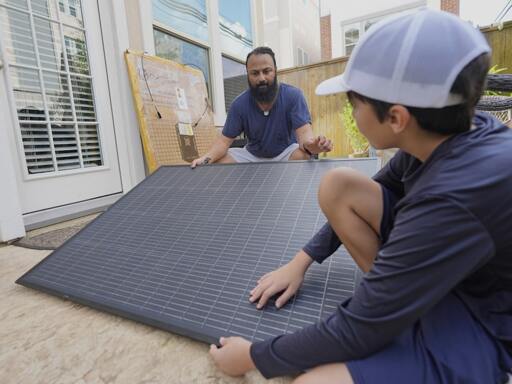
“Easy-to-install solar panels that plug into a regular outlet are getting attention just as Americans are worried about rising energy costs. That’s because these plug-in or balcony solar panels start shaving off part of a homeowner’s or renter’s utility bill right away.
“”A year ago, nobody was talking about this,” says Cora Stryker, co-founder of Bright Saver, a California nonprofit group that advocates for plug-in solar. The panels are already popular in Germany, where more than 1.2 million of the small plug-in systems are registered with the German government.”
You can buy the kit for $2,500. Using my rates and usage, it’s still not worth it.
Monthly savings
$21.25
89 kWh offset
New est. bill $90.01 down from $111.26
Annual savings $255 per year
9.8 yrs to break even
What size of unit did you calculate with? Typically the ones sold in Europe are below 1000€, some even as cheap as 600€.
It’s all on their website:
https://www.brightsaver.org/backyard-solar-with-battery
It seems to include a battery, which would not be necessary if you just want to save money rather than it being useful in a blackout (although their website says you can’t using in a blackout). Removing the battery element would decrease the cost a lot.
In the US, not necessarily. Connecting power generators to the grid without a permit from an electriction is technically illegal. Most utilities will charge you or even get you in trouble if it’s reported to them, or you send power back through the meter, hence the standard approach is to dump the power into batteries and just run devices off that.
And even in places like Utah (which just legalized this), the battery-less panels are still expensive.
I don’t know why. Maybe scaling+competition hasn’t kicked in to bring prices down? It could also be that 120V inverters are less common and more expensive?
You can probably order one for half the price 🤷
@FaygoRedPop That sounds about the same break-even rate I calculated for my rooftop solar.
And for someone renting it’s that or nothing, so 10 years to break even vs never breaking even seems like a decent deal