

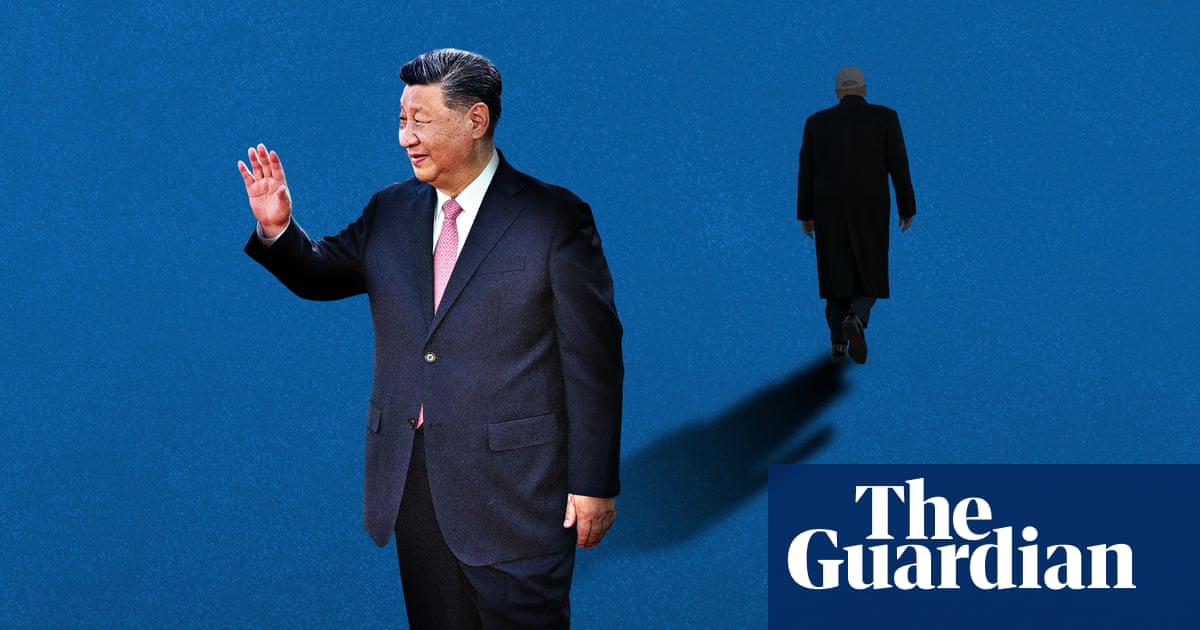
In the search for stability, some western nations are turning to a country that many in Washington see as an existential threat
If geopolitics relies at least in part on bonhomie between global leaders, China made an unexpected play for Ireland’s good graces when the taoiseach visited Beijing this month. Meeting Ireland’s leader, Micheál Martin, in the Great Hall of the People in Beijing, China’s president, Xi Jinping, said a favourite book of his as a teenager was The Gadfly, by the Irish author Ethel Voynich, a novel set in the revolutionary fervour of Italy in the 1840s.
“It was unusual that we ended up discussing The Gadfly and its impact on both of us but there you are,” Martin told reporters in Beijing.
China is on a charm offensive with western leaders, a path cleared by Donald Trump’s increasingly erratic and destabilising power grabs on the global stage. Although Europe breathed a sigh of relief this week when Trump withdrew the threat of using military force in Greenland and said he would not impose tariffs on opponents of his plans in the Arctic, the US no longer seems like a reliable partner.
Which is really the definition of fascism… But so is the US to a large extent.
Definitely.
Especially under Trump, but also at various times in the past, has the US used corporations as an extension of foreign policy, and used foreign policy to help major corporations. Not just wars for oil (the most obvious case), but also leaking intelligence to help US companies, or using US companies to hurt people abroad that the US disagrees with (like ICC judges).
I don’t know how many examples there are of China doing similar things. Around the introduction of 5G phone networks, the US was paranoid about Huawei involvement because China might use it to spy on us. Their control is such that they could. No idea if it’s actually happening. But US cloud platforms are definitely sharing data with the US government.