
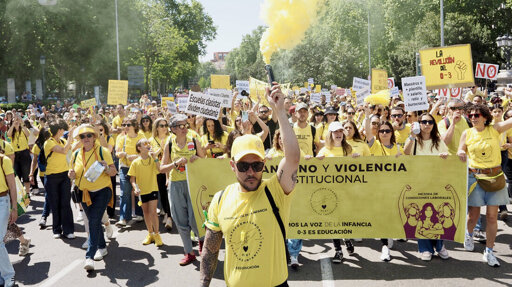
In April, there were already teacher protests at various public schools in Spain. On 21. May was mobilized again. What are you asking for?
It is about fundamental questions of our working conditions. One of the most important requirements is the reduction of class sizes. At my institute in Madrid, many colleagues have classes with 35 or more students in the Bachillerato, i.e. in high school. This not only means a huge burden during, but also outside of school time: preparing lessons, correcting exams, providing individual support. We also call for fewer bureaucratic tasks and lessons. Of course, it is also about salaries. In the Madrid region, teachers are among the worst-paid in the entire state despite the high cost of living. Originally, the idea was that there should be “encierros”, i.e. occupations or overnight protests, at the schools. In the meantime, however, the concept has been opened. Each teacher meeting at the respective schools can decide for itself which form of protest takes. It is crucial that the colleagues organize themselves.
In Spain, education policy is primarily the responsibility of autonomous regions. Does the long-standing government of the Partido Popular in Madrid have any influence on the situation?
Absolutely. The government of the Partido Popular likes to present Madrid as one of the wealthiest regions of Spain with a very high purchasing power. But this prosperity is not reflected in the working conditions of workers in public education. At the same time, we have been experiencing a policy of privatizing education for years. This worsens both the conditions for teachers and the quality of education for pupils.
How does this privatization show concrete?
Public funds are increasingly directed into “concertados”, i.e. semi-private schools. At the same time, new private or semi-private facilities are created in many districts, while public schools are hardly developed. This has serious consequences. In some districts, public schools are increasingly segregated. Families also make their decisions which schools are financially and politically funded. In addition, there are state aids that favour enrolment in semi-private schools.
Display
Recently there were also protests at the universities, for example at Complutense University in Madrid. Is that related to the same problems?
Yeah. The regional government increases annually the funds for private and semi-private educational institutions. At the same time, public universities are put under financial pressure. This leads, for example, to the fact that schedules are restricted or that there are fewer offers – particularly problematic for students who have to work alongside their studies. This is the same political logic as in school.
Spain is currently governed by an allegedly progressive government at national level. Does the central government do enough?
There are discussions and individual measures, but many key demands remain unfulfilled. So far, there is no state regulation that would significantly reduce the teaching obligations of teachers. The problems remain. We can’t just wait for changes to happen at some point. The pressure must also come from below.
In recent years, there have been debates on political influence in schools, for example in regions where the right-wing party, Vox, is involved. Do you see similar conflicts in Madrid?
We experience other forms of political influence. A few months ago, a lot was discussed that the regional government financed courses on the history of terrorism in Spain, where it was claimed that the Basque organization ETA continues to exist. Such measures show how education policy is ideologically used. There were also incidents at our own institute. Last year, the historical building of San Isidro was used for the opening of the cultural event »Veranos de la Villa«. One of the guests was then Vox-Member Javier Ortega Smith. He kept a very aggressive and homophobic speech there and transfeindian speech. Some teachers who still worked at the institute were open to him. On the same day, one of our colleagues received threats.
That sounds like an atmosphere of intimidation.
Yes, absolutely. Many people only see teachers as state officials. Fear is spreading among us. More and more colleagues hesitate to publicly express a clear political opinion. This is why mobilizations are important. It is also about defending public school as a democratic space.